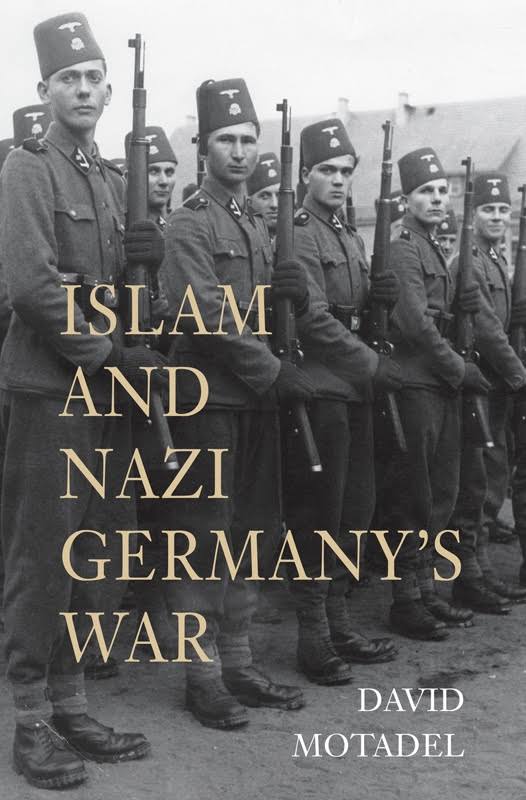
At the end of 2017, the book Islam and Nazi Germany’s War, written by the 37-year-old German historian David Motadel, who teaches at the London School of Economics, appeared in a German translation. The award-winning book had originally been published in English four years ago.
David Motadel is able to prove that several hundred thousand Muslims fought alongside the Nazis in the Second World War. The recruitment for and propagation of this German-Muslim collaboration was, among many others, promoted by the highest Muslim cleric in Palestine, the Mufti Amin al-Husseini, who remained even after 1945 the undisputed Palestinian leader. In the Islamic, especially in the Arab world, the problems of the Holy Land played an important role. This however did initially not preoccupy the German government.
After the Italian military’s debacle in North Africa and the Balkans in early 1941, the German attitude changed. In this year, when German troops were operating in North Africa, the Foreign office began to worry about its affiliation with Islam. Despite the skepticism – the German diplomats still remembered that this policy had not yielded, during the First World War the hoped-for success – a systematic instrumentalization of Islam was decided. These efforts were coordinated by the experienced career diplomat Dr. Wilhelm Melchers, who had formerly been based in Addis Ababa, Tehran and Haifa. Another important figure was Dr. Franz Grobba, an orientalist who had already been the commander of a regiment of Muslim volunteers during the First World War and had served in Palestine. Both Melchers and Grobba knew the most prominent religious cleric whom they wanted to engage for German service: Amin al-Husseini, Mufti of Jerusalem, hailing from the clan of Husseinis, who had made a name for themselves as Feudal lords. After the outbreak of the war, the French put pressure on the Mufti, who had fled to Lebanon, to solidarize himself with the Western powers. He later escaped to Iraq in October 1939, where he was received enthusiastically. In a personal letter to Hitler, which was handed over to him mid-February of 1941, the Mufti stressed the Arab peoples’ warmest sympathy for Germany and the Axis. Husseini also drew attention to the Jews, these dangerous enemies with their secret weapons, finance, corruption and intrigues, and who had joined forces with the British in order to realize their dreams in Palestine and even in the adjacent countries. Plans were made for the development of a secret service in the entire Middle East and sabotage in Palestine. Weapons should be delivered for uprisings in Palestine and Transjordan.
In October 1941, the Wehrmacht created the special company Bergmann, a unit of Turkmen commanded by Theodor Oberländer, who, after the war, made a career in the Federal Republic. A month later, additional Muslim units were created, whose military attitude seemed satisfactory to Berlin. On December 12, 1942, Hitler asserted during a dinner conversation that caution should be exerted with respect to the organization of Eastern units, and that he only trusted the “Mohammedans”. With Hitler‘s approval, the Eastern legions were created. The first two were the Turkestan legion, drafted on January 13, 1942, and the Caucasian-Mohammedan Legion, both with almost exclusively Muslim soldiers. They were followed by the Armenian Legion and the Georgian Legion, joined by the North Caucasian Legion in August and the Volga-Tatar Legion in September. The commanders and permanent staff were German.
In 1943 there were already 79 infantry battalions, of which 54 were Muslim. Three of them were in Stalingrad and many fought in the Caucasian mountains. Some battalions fought on the Balkans against Tito‘s partisans and six battalions participated in the defense of Berlin in 1945. It is estimated that the Wehrmacht was able to recruit more than 200,000 Muslims from the Soviet Union alone.
Starting in 1943, even Muslim prisoners of war who were too weak for heavy physical work were grouped together in work units. Many thousands of Muslims worked in auxiliary units and by the end of the war tens of thousands of the Eastern legions’ Muslim soldiers had fallen. British and French had also mobilized hundreds of thousands of Muslim soldiers though.
The German general in Croatia, Edmund Glaise von Horstenau, joked about Himmler‘s enthusiasm for the establishment of a Muslim unit in Bosnia, commenting that Muslims should be transformed into „Muselgermans”. Starting in February 1943, the SS 13th Arms Mountain Division was created, which was later called Handschar. Approximately 20,000 Muslims were recruited, who were praised by German propaganda in Croatia as fighters „against Bolshevism and Judaism“. Far from their families in France the SS Muslims were disappointed, since they had been promised, during their recruitment, that they would be stationed in their home country. In mid-September 1943, a mutiny broke out. This uprising was immediately quashed and many of the participants were arrested and publicly executed. Handschar was transferred to Neuhammer in Silesia, where it was visited by both Himmler and al-Husseini.
Parts of the division were used at the turn of the year 1943/44 in northern Bosnia, where they „put down everything that did not wear a fez,“ so that even Muslims fled from their atrocities to the partisans. From April to October 1944 a big area between Sava, Drina and Bosna was ruled by the SS. While most areas inhabited by Muslims were dominated by Partisans, Handshar acted as occupier of a mostly Christian population. The Mufti used young Imams to incite the soldiers. Although he no longer believed in Germany’s victory, he had the soldiers indoctrinated until the end to sacrifice their lives for a Nazi triumph. In July 1943, Himmler told the Mufti that three million Jews had already been murdered. Historians argue about the spirit that reigned on the Arab side in the former Palestine Mandate. It is undeniable, however, that by 1943, 8,000 Arabs, including 7,000 from Palestine, had deserted from the British army and descended into the underground.
In January 1942, during a conversation with General Hellmuth Felmy, the Mufti and al-Gailani had fantasized about Arab divisions which could be mobilized, but the establishment of Arab collaboration units in association with the Special Staff F remained far below expectations.
Many volunteers asked for release in order to study in Germany. Therefore, the Wehrmacht advised to cut scholarships for Arab students. After more than half a year of its existence, the German-Arab University Department counted only 243 Arabs in August of 1942, of which 112 were Syrians or Palestinians. Muslim soldiers fought until the end on Germany’s side. At the end of the war however it became difficult to uphold the discipline and morale of the troops, for there were many desertions. In autumn 1944 Handschar fell apart. Due to the growing number of deserters, the SS was forced to demobilize the division. On October 29, 1944, the German ambassador in Zagreb reported that 2,000 men had been disarmed and drafted into labor service.
There were not many desertions among the Muslim soldiers from the Soviet Union. However, when Turkestan Wehrmacht soldiers fled to the Albanian partisans, they not only carried their weapons, but also - as the British liaison officer Julian Amery reported - wrapped in a large green handkerchief, the cut ears of their German officers.
The Mufti of Jerusalem was appreciated by some personalities in Germany after the war as well. In December 1951, the Journal for Geopolitics published an interview with him about German-Arab relations. The Foreign Office also remained in contact with al-Husseini. Of all, Werner Otto von Hentig, who since the early 1950s had re-entered the Diplomatic Service tried again to work with him.
David Motatel achieved a great opus of 568 pages. It is the first overall presentation of Nazi German efforts to take advantage of Islam and its followers during the Second World War.